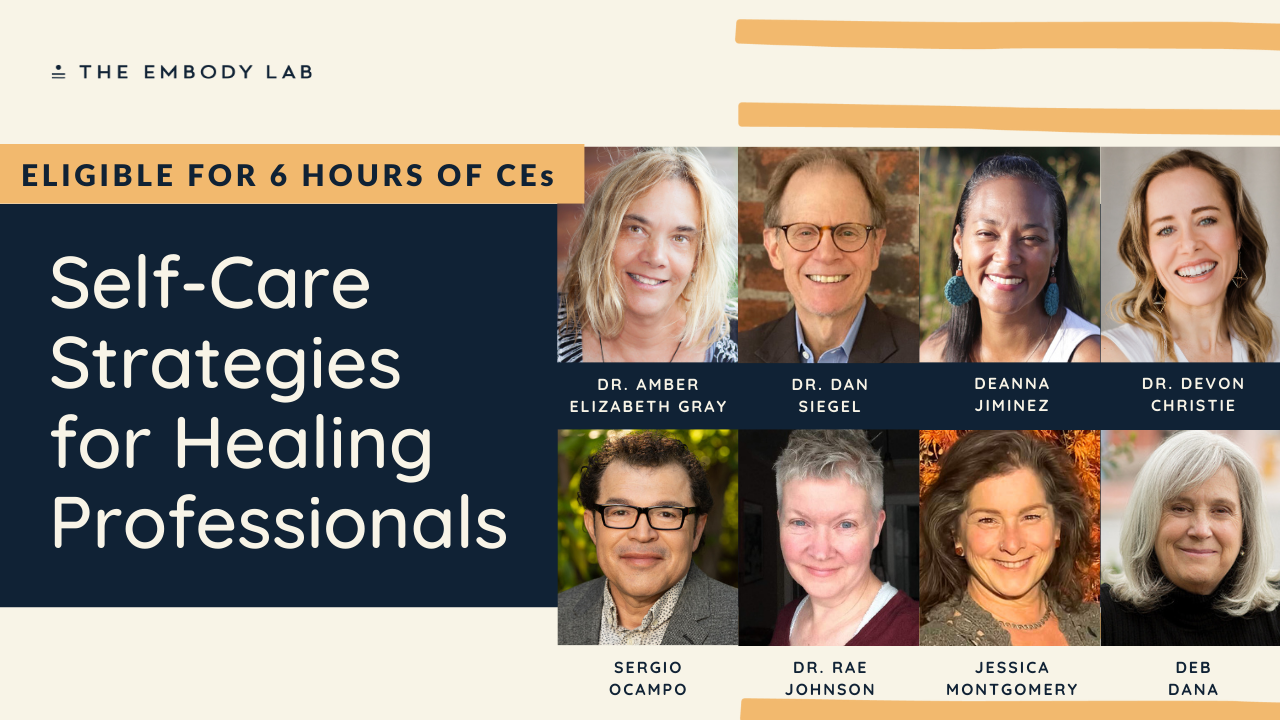
Self-Care Strategies for Healing Professionals
$397 USD $197
On-Demand Course Length: 6 Hours
"Self-Care Strategies for Healing Professionals," is designed to equip mental health practitioners with essential tools and perspectives for sustaining their well-being in demanding roles. It emphasizes self-care as an ethical and moral imperative, highlighting the crucial connection between embodied self-awareness, personal replenishment, and effective therapeutic presence. The modules address the risks of empathetic distress and burnout, providing practical strategies for emotional regulation, setting boundaries, and cultivating resilience through consistent self-care practices. UltiMatély, this program reframes self-care not as an indulgence but as a vital act of self-preservation and a continuous journey of balancing demands with resources to ensure a fulfilling and impactful healing practice.
ADD TO CARTAbout the course
Self-Care Strategies for Healing Professionals
As therapists and healing professionals, we often find ourselves overgiving, overworking, and neglecting our own needs in service of others. But burnout doesn't always feel like or look like exhaustion. Sometimes it appears as numbness, irritability, resentment, or a growing sense of disconnect from the work we once loved. Over time, our capacity to be present, creative, and compassionate quietly erodes—not because we're not strong enough, but because we were never meant to pour from an empty cup.
A Return to Yourself:
This course, led by Dr. Scott Lyons, founder of the Embody Lab, is a return: a return to your body, to breath, to boundaries, to the nervous system rituals that sustain you as you hold space for others. It is a return to your own sustainable brightness so that you can continue being a guiding light for others. Because self-care isn't self-indulgence—it's self-preservation. It's an ethical imperative. And it's what makes sustainable practice possible.
What You'll Learn:
Through six comprehensive modules from expert faculty, plus golden nuggets of wisdom from special guests Deb Dana and Dr. Dan Siegel, you'll discover how to:
Module 1: Embodied Self-Care for Mental Health Professionals with Dr. Amber Elizabeth Gray
Self-Care as Ethical Obligation:
- Understand self-care as ethical and moral responsibility for practitioners
- Recognize importance especially when working with trauma survivors
- See self-care as essential for personal well-being and effective practice
- Frame it as professional requirement, not optional luxury
Embodiment Practices:
- Practice weight and breath awareness exercises
- Increase physical comfort and presence
- Cultivate interoception (awareness of internal body states)
- Use body awareness as foundation for self-care
Yielding and Ease:
- Integrate concept of "yielding" to gravity
- Promote ease and efficient movement
- Use imagery (bunny rabbit's graceful leap) for understanding
- Reduce unnecessary tension and effort
Compassion, Empathy, Sympathy:
- Understand difference between sympathy, empathy, and compassion
- Cultivate compassion rather than sympathy (which can deplete)
- Maintain healthy boundaries while remaining connected
- Work from wisdom gained through extensive experience with survivors of political violence, torture, war, genocide, trafficking, combat
Module 2: Somatic Practices for Practitioner Well-being - Release, Replenishment, and Joy with Deanna Jimenez
Understanding Depletion:
- Recognize clinicians frequently experience emotional depletion
- Understand we cannot give endlessly without replenishment
- Identify risks inherent in clinical practice
- Acknowledge fundamental need for consistent self-care
Building Capacity:
- Build capacity for holding space like strengthening muscle
- Develop ability to attune somatically with clients through practice
- Avoid over-reliance on techniques that leads to burnout
- Recognize capacity-building as ongoing process
Release Practices:
- Develop consistent practices for releasing clients' emotional burdens
- Name specific resources for releasing clients' stories
- Create rituals for leaving work at work
- Understand difference between release and replenishment
Replenishment and Joy:
- Actively engage in activities that bring genuine joy
- Identify variety of nourishing activities
- Integrate these with intentional frequency into life
- Prioritize pleasure and delight, not just rest
Co-Care Network:
- Cultivate strong network of co-care
- Build personal and professional support relationships
- Understand connected relationships expand capacity to be present
- Counter inherent limitations of being human in therapeutic role
- Assess and refine support networks regularly
Ongoing Journey:
- Acknowledge human limitations honestly
- Honor own experiences and needs
- Intentionally develop resources for sustaining well-being
- Enhance therapeutic presence through personal nourishment
Module 3: Walking an Authentic Path of Service - Embodiment and Self-Care for Healers with Dr. Devon Christie
Defining Self-Care:
- Understand self-care as ability to identify and meet own needs
- Recognize as clinical and ethical imperative
- See as ongoing, responsive process
- Understand it benefits both practitioner and clients
Embodied vs. Conceptual Awareness:
- Conceptual self-awareness: Intellectual understanding of self
- Embodied self-awareness: Finely tuned resonant capacity to respond to world
- Recognize embodied awareness as crucial for emotional regulation
- Link to trauma healing and effective therapeutic presence
- Identify practices to cultivate embodied awareness
Risks of Relational Healing:
- Identify empathetic distress and its impact
- Recognize pathway to burnout
- Understand how unmanaged empathy depletes
- See need for boundaries and self-regulation
Cultivating Resilience:
- Practice rest as active strategy
- Use self-regulation techniques for nervous system
- Develop energetic awareness practices
- Build capacity to sustain challenging work
Pathological Altruism:
- Understand concept of pathological altruism (helping that harms self)
- Prioritize own needs without guilt
- Foster clients' innate healing intelligence
- Balance compassion for others with compassion for self
- Avoid harm to both practitioners and clients through over-functioning
Module 4: Preventing and Healing Burnout - The Generative Power of Self-Inclusion for Practitioners with Jessica Montgomery
Including Yourself:
- Practice self-inclusion in service work
- Explore initial motivations for entering field
- Use internal reflection and memory recall
- Reconnect with original calling
Core Values Alignment:
- Identify core values driving work
- Assess coherence between values and current work experience
- Recognize when misalignment causes depletion
- Understand how passion and motivation sustain energy
- Realign work with values when drift occurs
Differentiation Practices:
- Maintain boundaries between self and clients
- Prevent conflation of client and practitioner experiences
- Understand differentiation as essential for sustainable generosity
- Recognize boundaries enable rather than limit true service
- Apply practical strategies for maintaining distinction
Luxurious Rest Practice:
- Experience deep relaxation beyond typical rest
- Quiet body and mind intentionally
- Facilitate return to work with renewed creativity
- Cultivate self-awareness through rest
- Distinguish rest from mindfulness
- Understand rest as generative, not indulgent
Sustainable Service:
- Recognize own well-being as vital resource for service
- Understand you cannot serve from depletion
- Build practices that sustain rather than drain
- Honor yourself as instrument of healing work
Module 5: Self-Care as Dynamic Homeostasis for Mind-Body Practitioners with Dr. Rae Johnson
Dynamic Balance:
- Define self-care as achieving balance between demands and resources
- Understand experiencing more demands than resources leads to overwhelm
- Recognize crisis as situational rather than personal failing
- See self-care as dynamic process, not static state
Challenging Consumer View:
- Move beyond consumerist self-care ("treat yourself")
- Broaden understanding to include systemic factors
- Recognize structural demands and available support
- Avoid shame-based approaches
Mapping Demands and Resources:
- Map internal and external demands across life territories:
- Physical
- Spiritual
- Relational
- Emotional
- Psychological
- Identify internal and external resources in each territory
- Create personalized map of imbalances
- Enhance awareness of available support systems
Finding Accessible Resources:
- Identify quick, easy resource options
- Build shame-free resource repertoire
- Recognize small acts count
- Avoid perfectionism in self-care
Practical Next Steps:
- Reduce demands where possible (say no, delegate, simplify)
- Add resources strategically (support, tools, practices)
- Identify early warning signs of personal imbalance
- Proactively build resources before crisis
Self-Care as Activism:
- Frame self-care as self-preservation, not self-indulgence
- Understand self-care as form of activism
- Recognize complementary roles of self-care and community care
- See sustainable practice as resistance to burnout culture
Module 6: Healing Practitioner Burnout - A Somatic Perspective on Self-Regulation with Sergio Ocampo
Burnout Post-Pandemic:
- Recognize increased stress and workload since COVID-19
- List primary causes of practitioner burnout
- Identify various symptoms:
- Lack of interest in work
- Compassion fatigue
- Depersonalization
- Chronic fatigue
- Emotional exhaustion
Somatic Understanding:
- Analyze nervous system dysregulation in burnout
- Understand chronic fight-flight activation
- Recognize autonomic nervous system's role
- See how practitioners' own early difficulties exacerbate susceptibility
- Connect to vicarious traumatization
Immediate Regulation Techniques:
- Soft gazing: Peripheral vision to calm nervous system
- Self-embrace with breathwork: Supportive touch with breath
- Specific eye movements: To discharge activation
- Eye cupping: Darkness and warmth for nervous system reset
- Apply these techniques in moments of overwhelm
Long-Term Sustainability:
- Engage in ongoing self-work (potentially somatic therapy)
- Set clear work boundaries (time, emotional, energetic)
- Prioritize daily self-care:
- Diet and nutrition
- Exercise and movement
- Vocational interests outside work
- Cultivate mindfulness practices
- Regulate own nervous system to effectively support clients
Core Insights from Deb Dana:
The Menu Approach: Self-care isn't one-size-fits-all or a rigid schedule. Create a personalized menu of practices across different energy levels and needs:
- Movement (from listening to music to playing tennis)
- Connection to spirit
- Connection to others
- Feeding your brain and mind
- Various activities requiring different energy levels
Then ask daily: "What does my nervous system want to do today?" This honors that someday you won't want to go to the gym, and powering through may not actually nourish your nervous system.
Tracking is Essential: We all have days that "really sucked." That's okay. But if you have a string of those in a row, your nervous system is trying to tell you something:
- One bad day: Something didn't work today, notice and adjust
- String of bad days: Pattern developing toward burnout
Use simple end-of-day reflection with a pie chart:
- How much was ventral (safe, connected)?
- How much was sympathetic (activated, stressed)?
- How much was dorsal (shut down, numb)?
If your charts for a week land you repeatedly in sympathetic or dorsal, stop and pay attention. If you keep going, you'll get physically or psychologically sick. That is what happens.
The Solitude-Social Continuum: Know where you land. During the pandemic, Deb's inbox flooded with social suggestions (cocktail parties on decks, etc.). She felt like a "misfit" because she didn't want any of it—until she realized her nervous system is wired differently, landing more on the solitude end.
You're not doing it wrong if you need less (or more) social connection than others suggest. The world says contradictory things: "Be independent" and "You should be having lunch with people." Whenever you hear "should," recognize it's not a ventral regulated word. "Should" comes from survival energy—someone saying "or else." This triggers the nervous system to feel judged.
Replace "should" with "What would you like to do today?" And some of it really is good if it involves other people—to whatever degree you want.
Nervous System with Nervous System: Humans need connection. We don't need it all the time, but we do need it. Some self-care activities should involve other people because co-regulation matters. But how much and what kind depends on where you land on the solitude-social continuum. Honor your wiring.
Core Competencies Developed Across All Modules:
Understanding Burnout:
- Recognize burnout doesn't always look like exhaustion
- Identify early warning signs (numbness, irritability, resentment, disconnect)
- Understand vicarious trauma vs. burnout
- Track patterns before they become crisis
- Acknowledge situational vs. personal factors
Embodied Awareness:
- Practice weight and breath awareness
- Cultivate interoception
- Yield to gravity for ease
- Develop embodied vs. conceptual self-awareness
- Use body as primary source of information
Nervous System Literacy:
- Understand ventral, sympathetic, dorsal states
- Track your nervous system throughout day
- Use pie chart for daily reflection
- Notice when you're in survival states
- Build pathways back to regulation
Creating Your Menu:
- Identify practices across different energy levels
- Include movement, spirit, connection, nourishment
- Build range from passive to active
- Honor your solitude-social continuum
- Ask daily what your nervous system wants
Release and Replenishment:
- Distinguish between release (letting go) and replenishment (filling up)
- Develop consistent practices for releasing clients' stories
- Identify activities that bring genuine joy
- Integrate nourishment with intentional frequency
- Build capacity like strengthening muscle
Boundaries and Differentiation:
- Maintain distinction between self and clients
- Practice differentiation to prevent conflation
- Set work boundaries (time, emotional, energetic)
- Understand boundaries enable generosity
- Say no without guilt
Values Alignment:
- Reconnect with initial motivations
- Identify core values
- Assess coherence with current work
- Realign when drift occurs
- Let passion sustain energy
Demands and Resources:
- Map demands and resources across life territories
- Identify imbalances before they become crisis
- Reduce demands where possible
- Add accessible resources strategically
- Recognize early warning signs
Somatic Regulation:
- Apply immediate techniques (soft gazing, self-embrace, eye movements, eye cupping)
- Use breathwork for nervous system regulation
- Practice rest as active strategy
- Build long-term resilience through body-based practices
Co-Care Networks:
- Cultivate personal and professional support
- Recognize limitation of doing it alone
- Expand capacity through connected relationships
- Engage in mutual support
- Build community care alongside self-care
Pathological Altruism Awareness:
- Recognize when helping harms self
- Prioritize own needs without guilt
- Avoid over-functioning
- Trust clients' innate healing intelligence
- Balance compassion for others with self-compassion
Expert Faculty:
Learn from Dr. Amber Elizabeth Gray, Deanna Jimenez, Dr. Devon Christie, Jessica Montgomery, Dr. Rae Johnson, and Sergio Ocampo, with golden nuggets of wisdom from special guests Deb Dana (Polyvagal Theory) and Dr. Dan Siegel (interpersonal neurobiology).
Why Self-Care is Not Optional:
This isn't about spa days or bubble baths (though those might be on your menu). This is about the fundamental truth that:
- You cannot pour from an empty cup
- Your capacity erodes over time without nourishment
- Burnout makes you less effective, not more dedicated
- Self-care is an ethical obligation to clients
- Your nervous system needs daily tending
- Sustainable practice requires sustainable self
As Deb Dana says: If you keep going when your nervous system is telling you to stop, you'll get physically or psychologically sick. That is what happens. The nervous system has all the information we need—we just need ways to listen and track.
The Ethical Imperative:
Self-care isn't selfish—it's required. You are the instrument through which healing happens. When that instrument is depleted, dysregulated, burnt out, the quality of care suffers. Taking care of yourself isn't separate from taking care of clients; it's foundational to it.
Dr. Amber Elizabeth Gray, drawing from extensive work with survivors of political violence, torture, war, genocide, trafficking, and combat, frames self-care as a moral obligation. If we're asking clients to heal, to do difficult work, to build capacity—we must model this ourselves. We must walk the path we're asking them to walk.
From Deb Dana's Wisdom:
Vicarious trauma changes your view of the world because of ongoing connection with people whose stories impact you. Burnout overwhelms you with working circumstances. Self-care is important for either—but it must be personalized, tracked, and honest.
You can't just say "I'll go to the gym five days a week" and call it self-care. Your nervous system someday will say "I don't want to go today." If you power through, you may still go, but you may not be nourishing your nervous system. Self-care is about nourishing your nervous system across different categories, with a menu of choices that matches where you actually are each day.
And it requires tracking. Because we all lie to ourselves. We all think "I'm fine" when we're not. But the pie chart doesn't lie. If your week is landing you repeatedly in sympathetic or dorsal, your body is telling you something. Listen before it forces you to listen through illness.
Self-Care as Activism:
Dr. Rae Johnson reframes self-care from self-indulgence to self-preservation and activism. In a culture that glorifies overwork and self-sacrifice, taking care of yourself is an act of resistance. It's refusing to participate in systems that demand we deplete ourselves. It's modeling for clients that worthiness doesn't come from exhaustion.
Self-care is activism because:
- It resists burnout culture
- It values wholeness over productivity
- It honors limits as wisdom, not weakness
- It sustains long-term change work
- It demonstrates that care includes self
Transformation Through Self-Care:
This course supports professionals in:
- Recognizing early signs of burnout before crisis
- Building personalized menu of self-care practices
- Tracking nervous system states daily
- Nourishing rather than depleting themselves
- Setting guilt-free boundaries
- Distinguishing between release and replenishment
- Cultivating co-care networks
- Aligning work with core values
- Balancing demands and resources
- Applying somatic regulation techniques
- Preventing pathological altruism
- Restoring connection to self and work
- Sustaining capacity for presence, creativity, compassion
- Returning to sustainable brightness
Who This Is For:
Essential training for:
- Therapists and counselors at risk of burnout
- Healing professionals feeling depleted
- Practitioners experiencing compassion fatigue
- Anyone working with trauma survivors
- Clinicians noticing disconnect from work they once loved
- Professionals experiencing irritability, resentment, numbness
- Those who've been "powering through" without nourishment
- Anyone who's noticed capacity quietly eroding
- Practitioners who know intellectually they need self-care but struggle to implement it
- Healing professionals ready to model what they teach
What Makes This Course Essential:
Most self-care training offers generic lists of activities. This course teaches you:
- How to create personalized menu based on your nervous system
- Why tracking is essential (and how to do it simply)
- The difference between release and replenishment
- How to work with your solitude-social continuum
- Immediate somatic techniques for overwhelm moments
- Long-term strategies for sustainable practice
- Why alignment with values prevents burnout
- How to map demands and resources
- The role of co-care in individual well-being
- Why self-care is ethical obligation, not luxury
The Core Message:
You were not meant to pour from an empty cup. Your capacity to be present, creative, and compassionate will erode over time if you don't actively nourish yourself. This isn't because you're not strong enough—it's because you're human.
Burnout doesn't happen all at once. It's the quiet erosion of capacity. It's the string of days that "really sucked." It's the growing disconnect from work you once loved. It's the numbness, irritability, resentment that creeps in. It's your nervous system screaming for attention while you power through.
But it doesn't have to be this way.
This course is a return: to your body, to breath, to boundaries, to the nervous system rituals that sustain you. It's a return to your own sustainable brightness so you can continue being a guiding light for others.
Because self-care isn't self-indulgence. It's self-preservation. It's an ethical imperative. It's what makes sustainable practice possible. And it's the foundation of everything else we do.
As Deb Dana reminds us: The nervous system has all the information we need—we just need ways to listen and track. This course gives you those ways. Not generic prescriptions, but personalized practices. Not "should" energy, but "what would you like?" curiosity. Not powering through, but truly nourishing.
Your sustainable brightness matters. Not just for you, but for everyone you serve. This course helps you reclaim it, sustain it, and honor it as the vital resource it is.
Welcome home. Welcome back to yourself. Welcome to self-care as the foundation of all the rest.
Join our brilliant experts for the following sessions:
DR. AMBER ELIZABETH GRAY
Dr. Amber Elizabeth L. Gray is a Dance/Movement Therapist, Somatic & Human Rights Psychotherapist, and long-time yoga and Continuum teacher. She works with survivors of war, torture, human rights abuses and historical trauma and oppression, in the US and in active and post conflict zones, refugee camps, and disasters. Equally activist, artist, advocate, author, mystic and therapist, her clinical, healing, educational and organizational work endeavors to promote reciprocity and empowerment and incite meaningful change. She brings her Polyvagal, Heart & Spirit-informed Right to Embody somatic human rights framework and Body of Change eco-somatic regenerative retreats to communities of therapists, artists, global citizens and change makers world-wide. Amber originated Polyvagal-informed Somatic & Dance/Movement Therapy through 25 years of immersive mentoring and exploration of Polyvagal Theory. This work is a survivor-centered, multi-cultural & social justice framework that reflects many years of co-inquiry with her clients to understand how Polyvagal Theory promotes restoration and healing in the body-heart-mind-spirit for survivors of egregious human rights violations. She has been teaching this work globally since 2003 and is the inaugural member of The Polyvagal Institute’s Editorial Board.
Website: www.ambergray.com
Facebook: www.facebook.com/AmberGrayMovementTherapies
Instagram: @restorativeresources
DEANNA JIMENEZ
Deanna Jimenez is an Assistant Professor at California Institute of Integral Studies in the Somatic Psychology Department and a somatic/transpersonal psychotherapist in private practice supporting individuals and couples.
Her clinical work is centered in the dialogue of mental health as it intersects with race, culture and spirituality. She received a Bachelor's in International Relations from UC Berkeley studying the efficacy of conflict resolution and cultural awareness in the international workplace. Following a career in corporate and non-profit fields, Deanna received her Masters from John F. Kennedy University in Transpersonal Counseling Psychology. Through an eclectic body of training, she uses a freedom-focused approach to support clients who have dedicated their lives to transformative justice movements. In supporting people of marginalized identities to build a solid spiritual, embodied foundation we raise collective consciousness while dismantling systems of oppression. To learn more about Deanna and her work, please visit: www.deannajimenez.com
DR. DEVON CHRISTIE
Dr. Devon Christie, a Clinical Instructor at UBC Department of Medicine, is a dedicated family doctor with a focus in chronic pain and mental health. In her clinical work at the Canadian Pain and Regenerative Institute, Numinus, and online psychotherapy practice in Vancouver, BC, she brings a holistic approach to her patients and clients. As a former clinical investigator and study therapist in MDMA-assisted therapy research for PTSD with MAPS, Devon is at the forefront of psychedelic therapy advancements. Her extensive certifications i n Functional Medicine, Mindfulness Based Stress Reduction, Relational Somatic Therapy, Level 1 Internal Family Systems, MAPS MDMA-Assisted Therapy, and ketamine-assisted therapy underscore her commitment to comprehensive healing.
Formerly the Numinus Senior Lead of Psychedelic Programs, Devon played a key role in developing and implementing psychedelic-assisted clinical and therapist training programs. Currently, she imparts her wisdom to therapists in renowned training programs such as CIIS, IPI, ATMA, VITAL, and EmbodyLab, prioritizing ethical practice, mindfulness, and trauma-specific skills.
Devon’s passion lies in reshaping the healthcare paradigm by integrating trauma-informed, bio-psycho-social approaches. She envisions the careful introduction of psychedelic-assisted therapies as a transformative step towards a holistic healthcare model, echoing the principles traditional systems of healing have long embraced. In her recently self-published e-book “Integrative Somatic Psychedelic-Assisted Therapy”, she outlines important elements of this paradigm shift.
Website: www.drdevonchristie.com
Facebook: www.facebook.com/DrDevonChristieMD
Instagram: @drdevonchristie
Publications and Podcasts: HERE
JESSICA MONTGOMERY
Jessica Montgomery MSW is a Hakomi Trainer, somatic counselor and counselor-educator based in Portland Oregon, USA. She offers integrative trainings across multiple scopes of practice, enhancing embodied mastery for bodyworkers, physicians, coaches, educators and therapists. With a background in intentional community and retreat facilitation, she offers her blend of mindful, somatic and ecstatic teachings internationally. Together with Donna Roy, she is the developer of Primary Attachment Therapy, a method for direct attachment remediation within secure therapeutic relationship.
Website: www.jessicamontgomerycounseling.com
DR. RAE JOHNSON
RAE JOHNSON, PhD, RSMT, BCC (they/them) is a board-certified coach, somatic movement therapist, and scholar/activist working at the intersections of embodiment and social justice. Rae is a professor of somatic psychology at the California Institute of Integral Studies and played a key role in developing the first Embodied Social Justice Certificate, an online program that brought together hundreds of thought leaders, practitioners, and community change agents to help shape the emerging field of embodied social justice. Rae is the author of several books, including Embodied Social Justice (Routledge, 2018) and Embodied Activism (North Atlantic Books, 2023). You can find them online at www.raejohnsonsomatic.com and on Instagram at @dr_rae_johnson
SERGIO OCAMPO
Sergio Ocampo is co-developer and instructor of Dynamic Somatic Touch (DST), an innovative and highly effective trauma resolution approach effective in unwinding emotional overwhelm, trauma, and physical syndromes such as chronic illness and pain. Based on the core values of somatic therapies, psychotherapy and body based sciences, DST complements and accelerates healing for all phases of trauma work.
Sergio combines somatic and cognitive interventions, including Somatic Experiencing, DST, Family Systems, Generational Trauma Resolution, Dream Work, Depth and Spiritual Psychology, Spiritual Awareness, and EMDR, to deliver innovative therapeutic approaches.
Sergio serves as a Somatic Experiencing Practitioner, Licensed Psychotherapist, Antioch University Adjunct faculty, and Embody Lab content contributor, while also holding leadership positions in Somatic Experiencing International and Dr. Peter Levine’s Ergos Institute of Somatic Healing. Fluent in four languages, Sergio advocates for seeing anxiety and depression as temporary. Sergio’s motto is: Emotional suffering and trauma are not a life sentence, but a temporary discomfort.
Websites: www.sergioocampo.com, www.dynamicsomatictouch.com
DEB DANA
Deb Dana, LCSW is an author, clinician, and consultant specializing in using the lens of Polyvagal Theory to understand and resolve the impact of trauma and create ways of working that honor the role of the autonomic nervous system. She developed the Rhythm of Regulation Clinical Training Series and lectures internationally on ways Polyvagal Theory informs work with trauma survivors. She is a founding member of the Polyvagal Institute, clinical advisor to Khiron Clinics, and an advisor to Unyte.
Deb’s clinical work published with W.W. Norton includes The Polyvagal Theory in Therapy: Engaging the Rhythm of Regulation, Polyvagal Exercises for Safety and Connection: 50 Client Centered Practices, and the Polyvagal Flip Chart. She partners with Sounds True to bring her polyvagal perspective to a general audience through the audio program Befriending Your Nervous System: Looking Through the Lens of Polyvagal Theory and her forthcoming print book Anchored: How to Befriend Your Nervous System Using Polyvagal Theory.
To learn more, visit www.rhythmofregulation.com or www.polyvagalinstitute.org
DR. DAN SIEGEL
Dr. Siegel is a clinical professor of psychiatry at the UCLA School of Medicine and the founding co-director of the Mindful Awareness Research Center at UCLA. He is also the Executive Director of the Mindsight Institute which focuses on the development of mindsight, teaches insight, empathy, and integration in individuals, families and communities.
Dr. Siegel has published extensively for both the professional and lay audiences. His five New York Times bestsellers are: Aware: The Science and Practice of Presence, Mind: A Journey to the Heart of Being Human, Brainstorm: The Power and Purpose of the Teenage Brain, and two books with Tina Payne Bryson, Ph.D: The Whole-Brain Child, and No-Drama Discipline. His other books include: IntraConnected, The Developing Mind, The Pocket Guide to Interpersonal Neurobiology, Mindsight, The Mindful Brain, The Mindful Therapist, and Becoming Aware. He has also written The Yes Brain and The Power of Showing Up with Tina Payne Bryson, Ph.D. Parenting from the Inside Out with Mary Hartzell, and NowMaps with Deena Margolin, LMFT and NowMaps, Jr.
Dr. Siegel also serves as the Founding Editor for the Norton Professional Series on Interpersonal Neurobiology which currently contains over eighty textbooks.
Websites: www.drdansiegel.com, www.mindsightinstitute.com
Facebook: www.facebook.com/drdansiegel
Instagram: @drdansiegel
LinkedIn: www.linkedin.com/in/drdansiegel
DR. SCOTT LYONS
Dr. Scott Lyons is a licensed holistic psychologist, educator and author of the book Addicted to Drama: Healing Dependency on Crisis and Chaos in Yourself and Others, with Hachette publishing. Scott is also the host of The Gently Used Human Podcast, a delightfully depthful and often hilarious exploration of what it is to be human, to have lived life, and come out gently used.
As a renowned body-based trauma expert, Doctor of Osteopathy (Spain) and Mind-Body Medicine specialist, Scott helps people to break free from cycles of pain, limited beliefs, and trauma. Scott is an innovator in transformative wellness and trauma therapy, teaching over half a million people internationally over the past twenty years how to relieve stress and restore vitality. Scott has worked with many of the country’s top leaders and CEOs as an executive coach and wellness consultant.
Scott is the creator of The Embody Lab—the largest online learning platform for body-based trauma therapies—and developer of Somatic Stress Release™, a holistic process of restoring biological resilience, taught in over 20 countries.
Scott is a Certified Body-Mind Centering™ Teacher and Practitioner, Cranio-Sacral Therapist, Visceral Manipulation Therapist, Neuro-Developmental Therapist, Infant Developmental Movement Educator, Registered Movement Therapist and Educator, Trauma Therapist, Somatic Experiencing Practitioner, Thai Massage Practitioner, Clinical Hypnotherapist, Mindfulness-based Executive Coach, Experiential Anatomy/ Developmental Movement and Yoga Practitioner, and a 500-hour registered yoga teacher. Additionally Scott holds a BFA in Theater/Psychology, MFA in Dance/Choreography, MS in Clinical Psychology, and a PhD in Clinical Psychology and Mind-Body Medicine.
Scott has been featured in The New York Times, Vanity Fair, Forbes Women, Fast Company, The Telegraph, The Guardian, INC., CNBC Make It, Fortune, Bustle, Reader’s Digest and Goop. He has also appeared on The Mel Robbins Podcast, The Jordan Harbinger Show, The We Can Do Hard Things Podcast, The Mental Illness Happy Hour, The Human Upgrade, The Genius Life, and The Chopra Well.
Websites: www.TheEmbodyLab.com, www.drscottlyons.com
Instagram: @DrscottLyons
Book: https://www.drscottlyons.com/addicted-to-drama-book

Guided full-length demonstrations
Observe four full-length somatic therapy sessions with clients. Each demonstration has a detailed breakdown and guided reflections of the session.

Powerful tools for your practice
In each session, the facilitator will walk you through what they did, why they did it, and how to adapt the same tools to your own practice.

Learn on your schedule
Get lifetime access to all your sessions. Download videos, audio files, and complete transcripts. Learn anywhere, anytime, on your schedule.
What Customers Are Saying
George T.
"This course shifted how I see self-care—it's no longer optional, it's essential to my practice and wellbeing."
Anika D.
"Grounded, wise, and so needed. I finally feel resourced instead of depleted after client sessions."
Maya K.
"A compassionate, clear reminder that our care for others begins with how we care for ourselves."
List your practice on The Embody Lab’s Somatic Therapist & Practitioner Directory!
More somatic therapy seekers come to The Embody Lab in their search for the right therapist than to any other somatic therapy site. We’ll help your practice be seen by hundreds of thousands of potential clients seeking your services.
Join The Directory Here