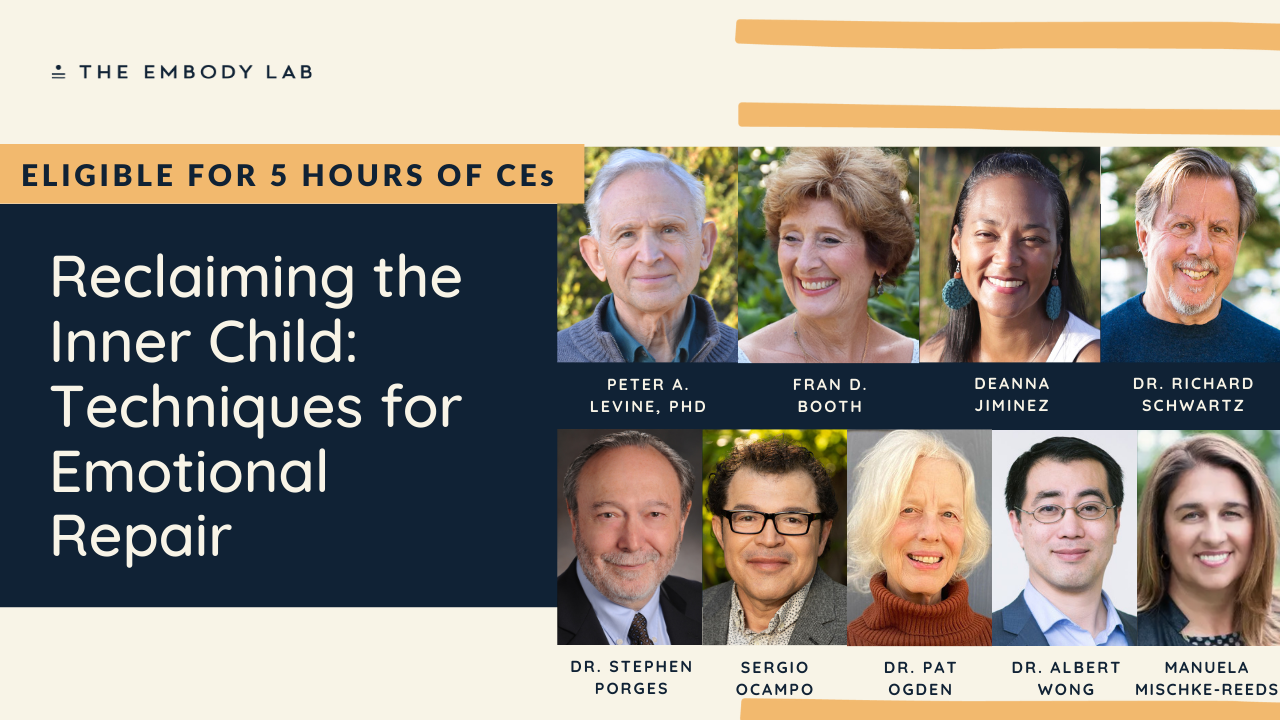
Reclaiming the Inner Child: Techniques for Emotional Repair
$397 USD $297
On-Demand Course Length: 5 HoursThis educational package offers a comprehensive exploration of the "inner child" concept, detailing its significance as a source of emotions, intuition, and creativity, and emphasizing its healing for individuals who have experienced trauma. It delves into how childhood experiences, particularly adverse ones, can disrupt development and create lasting imprints on the nervous system, leading to the formation of inner "parts" that carry trauma burdens. The program highlights somatic approaches, emphasizing the body as a trailhead to access and process past wounds, facilitate internal conversations with the inner child, and address implicit memories that live in the body. Ultimately, this educational package aims to guide individuals through releasing negative beliefs, retrieving the child from the past, and fostering greater well-being and integration by providing corrective and restorative experiences
ADD TO CARTAbout this course
Reclaiming the Inner Child: Techniques for Emotional Repair
Beneath many of our clients' struggles—chronic shame, anxiety, relationship challenges, perfectionism—lies a younger self still carrying unmet needs, unresolved grief, and the ache of not fully being seen. The inner child isn't just a metaphor. It's a lived, embodied experience that shows up in the therapy room as emotional overwhelm, reactivity, people-pleasing, or the persistent feeling of being "too much" or "not enough." This course, led by Dr. Scott Lyons, founder of the Embody Lab, invites you into deeply transformative work: helping clients not just understand their younger self, but finally feel safe, helped, and healed. Because when the inner child feels safe, the adult can finally exhale.
Beyond Analysis to Embodied Healing:
This isn't about talking about the inner child—it's about meeting the child part that still lives in the body, still uses the maps it created long ago, still carries the beliefs formed in moments of pain or rejection. This course teaches healing through somatic attunement, nervous system repair, and compassionate presence. You'll learn to facilitate not reliving but reworking—co-creating the missing experiences from childhood that were never received, so integration and wholeness can finally emerge.
A Critical Distinction: Reliving vs. Reworking:
As Dr. Pat Ogden emphasizes, we learned the hard way in the 1970s: taking people into reliving trauma—all the panic and terror—made them more distressed. They were reliving, not reworking. The difference?
Reliving: Both feet in the past, can't answer questions, living in trauma time, getting hijacked Reworking: One foot in present, one in past, trusted therapeutic relationship present, co-creating missing experiences
When you're there with them—attuned, empathizing, maybe even encouraging emotion—providing what Ron Kurtz called "a missing experience from childhood," that's when it becomes reworking. You're co-creating through the therapeutic relationship what was missing in childhood. That's the key to healing the inner child.
What You'll Learn:
Through five comprehensive modules from world-leading experts, plus golden nuggets from special guests Dr. Richard Schwartz, Dr. Pat Ogden, Dr. Peter Levine, and Dr. Stephen Porges, you'll discover how to:
Module 1: Trauma-Informed Inner Child Healing - Addressing Our Core Needs with Dr. Albert Wong
Defining the Inner Child:
- Understand inner child as source of emotions, playfulness, intuition, creativity
- Recognize its significance in emotional well-being and healthy relationships
- See it as part that holds childhood experiences and needs
- Connect it to creative expression and spontaneity
Core Needs of the Inner Child:
- Secure attachment: Connection, attunement, being seen
- Safety: Physical and emotional security
- Autonomy: Agency, choice, self-expression
- Understand "happy child" emerges when needs are met
- Recognize unmet needs lead to emotional distress and psychological difficulties
Trauma's Impact:
- Understand how trauma disrupts development
- Work with concepts of titration (small doses)
- Navigate resistance as protection
- Build resourcing before accessing wounds
- Complete the arousal cycle for integration
Healing Strategies:
- Provide corrective experiences in present
- Use affirmations that speak to child's needs
- Apply visualizations to connect with younger self
- Practice "traveling back in time" technique
- Foster integration and greater well-being
Module 2: Child States and Parts - A Hakomi Perspective with Manuela Mischke-Reeds
Inner Child States and Parts:
- Define how parts form in response to childhood experiences
- Understand parts as responses to specific states of being/consciousness
- See how childhood experiences impact adult functioning
- Recognize parts carry imprints from past
Developmental Impact:
- Explain trauma and adverse childhood experiences' effect on nervous system
- Understand disruption of developmental processes
- Recognize creation of lasting imprints on relational templates
- See how early experiences shape adult relationships and behaviors
The Missing Experience:
- Understand concept of providing what was never received
- Create safe space for accessing childhood wounds
- Offer corrective experiences to address unmet needs
- Use somatic approaches to facilitate healing
- Work with body to access and integrate child states
Somatic Approach:
- Focus on creating genuine safety in therapeutic space
- Track somatic indicators of child parts emerging
- Work with nervous system to support integration
- Honor developmental needs through embodied practice
Module 3: The IFS Perspective - Exiles, Protectors, and Self-Energy with Fran Booth
IFS Model for Inner Child Work:
- Understand roles of protectors, exiles (inner children), and Self
- Recognize trauma burdens carried by both protectors and exiles
- Work with protective system before accessing young parts
- Access Self-energy for healing
Using Body as Trailhead:
- Use somatic experience to access backstory of trauma
- Track body sensations connected to young parts
- Facilitate internal conversations between Self and inner child
- Let body guide the process
Common Inner Child Concerns:
- Fear of not being heard or believed
- Longing for parental repair that may never come
- Worry about rejection if they show themselves
- Belief they are fundamentally bad or wrong
- Fear of being abandoned again
The Unburdening Process:
- Create safe inner space full of Self-energy
- Release negative beliefs child carries
- Retrieve child from frozen moment in past
- Invite in new, positive experiences
- Witness transformation as burdens lift
Film and Illustration:
- Use visual examples to understand trauma landing in system
- See how Self-energy facilitates healing
- Witness unburdening process in action
- Understand power of Self-led healing
Module 4: The Embodied Nervous System and Somatic Self-Touch with Sergio Ocampo
Somatic Understanding:
- Define inner child as part still experiencing childhood in body
- Recognize child who was wounded or lonely is still present
- Understand how this causes adversity in daily life
- See inner child as experience living in body in present moment
Working with Nervous System:
- Address inner child wounding through nervous system
- Use somatic self-touch for regulation and connection
- Work with embodied experience, not just narrative
- Support nervous system to process and integrate past
Connecting with Inner Child:
- Practice connecting in various settings and contexts
- Tap into emotions that may have been in shadows
- Bring awareness to child part in present moment
- Foster emotional awareness through body connection
Somatic Techniques:
- Apply self-touch for nervous system regulation
- Use body-based interventions for child parts
- Create embodied sense of safety and presence
- Support integration through nervous system work
Module 5: Implicit Memory and Embodied Presence in Inner Child Healing with Deanna Jimenez
Memory and Trauma:
- Implicit memory: Body's unthought response to event
- Explicit memory: Conscious, cognitive memory of experience
- Understand trauma lives primarily in implicit memory
- Recognize both types must be addressed for healing
Somatic Therapy's Role:
- Focus on body's experience to access implicit memory
- Work with implicit and explicit memory simultaneously
- Allow implicit memory to be present and worked with
- Support integration of fragmented experience
Trauma as Rupture:
- Understand trauma as rupture of body's expectation of warmth and care
- Recognize role of interpersonal connection in healing
- Emphasize co-regulation as essential
- See trauma as relational wound requiring relational repair
Therapist's Presence:
- Remain regulated during client's recall of traumatic implicit experiences
- Provide disconfirming presence (different from original experience)
- Offer reparative presence (what should have been there)
- Create restorative experience through own regulation
- Emphasize importance of therapist's embodied presence
Core Insights from Dr. Pat Ogden:
The Inner Child as Map Maker: The inner child is the map maker who created the maps we still use today. Even if you don't use the term "inner child" with clients, you're working with it anyway—working with the part that made those early relational maps, those beliefs about self and world.
"Not Me" Self States: What's beautiful about inner child work is accessing and reclaiming parts we've put into exile—the "not me" self states. Caregivers define who the child is by what parts they accept and what parts they reject. There's no negotiation. It's all implicit. The child can't say, "Whenever I get sad, you reject me, so I have to stuff the sad part." That just doesn't happen. So the sad part becomes disavowed, exiled, "not me" because it wasn't accepted or welcomed.
Working in Third Person: In Sensorimotor Psychotherapy, we don't want people to become the child (that's reliving). We work in third person: "Can you see this little boy right now? Can you see his body position?" This maintains integrative capacity—one foot in present, one in past.
The Reunion: When clients sense the child part and feel the child's pain, it's deeply moving. It's a reunion with something that's been exiled. They feel more like "all of them" are here. People get more whole.
Clarifying Reality: Kids are confused. They don't know why their parent left or why their dad beat them. So we speak directly to the child part—not to convince the adult, but to provide what the child needed to hear: "I don't know why your mom left, but I do know it's not because of you. I do know you're not bad." When it comes in at that level, everything can shift.
Layers of Beliefs: Sometimes we think we're working with one belief ("everything's my fault"), but when it shifts, we discover a deeper belief underneath ("if you'll sit by my side, I'm not bad"). Beliefs have layers. One adaptive strategy covers up another. You work your way through.
The Strategy Creates New Beliefs: With the beliefs, we're working with the moment where the belief was formed (often about the self). But then there's also the strategy: "I must be bad, therefore I will never show myself again." That becomes the map used for a whole life. And the strategies create new beliefs—self-fulfilling prophecies. "Never show yourself" means nobody sees the real you, so they can't love you, which confirms the original belief.
Must Be Experiential: You can't do this top-down. It's got to be the experience of it. Not trying to talk anybody into anything. It's about helping the map maker shift the beliefs they've made about themselves or the world from the experience of it—from the reworking, from receiving what was missing.
Core Competencies Developed Across All Modules:
Understanding Inner Child:
- Recognize as lived, embodied experience, not just metaphor
- Identify how it shows up (overwhelm, reactivity, people-pleasing)
- Understand as map maker who created relational blueprints
- See as part carrying unmet needs and unresolved grief
Reliving vs. Reworking:
- Distinguish between reliving (both feet in past) and reworking (one foot in each)
- Maintain integrative capacity throughout work
- Stop if client can't answer questions (sign of reliving)
- Co-create missing experiences through therapeutic relationship
Accessing Inner Child:
- Notice when child part emerges (lip chewing, looking down, childish expressions)
- Ask: "Do you have an image? Do you feel it in your body?"
- Work in third person to maintain adult presence
- Track somatic indicators of young parts
Core Needs:
- Secure attachment and attunement
- Safety (physical and emotional)
- Autonomy and self-expression
- Being seen, heard, validated
- Having emotions welcomed and supported
Addressing "Not Me" States:
- Identify disavowed parts that weren't accepted
- Reclaim exiled aspects of self
- Welcome what had to be hidden
- Facilitate reunion with split-off parts
Somatic Approaches:
- Work with nervous system to access child parts
- Use titration to prevent overwhelm
- Build resourcing before accessing wounds
- Apply somatic self-touch for regulation
- Track implicit memory in body
Corrective Experiences:
- Provide missing experiences from childhood
- Clarify reality child was confused about
- Speak directly to child part with what they needed to hear
- Offer attuned, empathic presence
- Create disconfirming experience (different from original trauma)
IFS Integration:
- Work with protectors before accessing exiles
- Build Self-energy for healing
- Facilitate unburdening process
- Create safe inner space
- Support internal family system integration
Implicit Memory Work:
- Understand trauma lives primarily in body (implicit memory)
- Work with unthought responses, not just conscious memory
- Remain regulated as therapist when implicit memory emerges
- Provide reparative presence through own embodiment
Therapeutic Presence:
- Maintain one's own regulation
- Offer disconfirming, reparative, restorative presence
- Co-regulate through attuned connection
- Be the trusted relationship that allows reworking
- Embody what was missing in original relationships
Belief Work:
- Recognize layers of beliefs
- Understand strategies create new beliefs
- Work with moment where belief was formed
- Shift through experience, not cognitive convincing
- Track how beliefs become self-fulfilling maps
Expert Faculty:
Learn from Deanna Jimenez, Sergio Ocampo, Dr. Albert Wong, Fran Booth, and Manuela Mischke-Reeds—each bringing unique somatic, IFS, and Hakomi perspectives—with golden nuggets of wisdom from special guests Dr. Richard Schwartz (IFS creator), Dr. Pat Ogden (Sensorimotor Psychotherapy founder), Dr. Peter Levine (Somatic Experiencing® founder), and Dr. Stephen Porges (Polyvagal Theory creator).
Multiple Approaches, One Goal:
What makes this course comprehensive is the integration of multiple modalities:
- Trauma-informed perspective: Core needs, titration, resourcing
- Hakomi approach: Missing experience, somatic child states
- IFS framework: Exiles, protectors, Self-energy, unburdening
- Nervous system focus: Embodied experience, self-touch, regulation
- Memory work: Implicit and explicit, body-based processing
- Sensorimotor principles: Third person, clarifying reality, reworking not reliving
Each brings unique tools, but all converge on fundamental truth: the inner child is real, lives in the body now, and can be healed through attuned, embodied, relational repair.
Why This Work Matters:
The inner child isn't something that happened in the past—it's happening now. The maps made in childhood are still being used. The parts that were rejected are still in exile. The needs that weren't met are still driving behavior. The beliefs formed in moments of pain or confusion are still operating.
Until we access these younger parts with presence and compassion, until we provide the missing experiences that were never received, until we clarify the reality that confused child never understood, until we welcome back the disavowed "not me" states—clients remain fragmented, using outdated maps, living from protective strategies that no longer serve.
The Power of Co-Creation:
What makes this work transformative isn't just accessing the inner child—it's what happens in the therapeutic relationship when we do. We co-create what was missing. The therapist's attuned, regulated, compassionate presence becomes the corrective experience. The relationship itself provides what the original caregiving relationships could not.
This isn't about going back to change the past. It's about bringing the past into the present where, finally, in a safe, attuned relationship, it can be reworked, integrated, and healed.
Transformation Through Reunion:
This course supports professionals in helping clients:
- Access younger parts that still carry pain
- Distinguish between reliving and reworking trauma
- Provide missing experiences through therapeutic relationship
- Reclaim disavowed "not me" self states
- Shift core beliefs through embodied experience
- Complete arousal cycles that were interrupted
- Unburden child parts of what they've carried
- Work with implicit memory through nervous system
- Create safe inner space for all parts
- Facilitate reunion with exiled aspects of self
- Integrate fragmented experience into wholeness
- Help adult self finally exhale as child feels safe
Who This Is For:
Essential training for:
- Therapists working with developmental trauma
- Clinicians addressing chronic shame, anxiety, perfectionism
- Practitioners helping clients with relationship challenges
- Anyone working with people-pleasing and "not enough" patterns
- IFS practitioners wanting to deepen child exile work
- Somatic therapists integrating inner child approaches
- Hakomi practitioners focusing on missing experiences
- Trauma therapists preventing reliving while supporting reworking
- Any professional ready to move beyond talk therapy into embodied repair
What Makes This Course Profound:
Most inner child work happens through visualization or dialogue alone. This course teaches you to:
- Work through the body where child parts actually live
- Maintain integrative capacity (prevent reliving)
- Co-create missing experiences relationally
- Address implicit memory, not just explicit
- Work with nervous system for actual integration
- Facilitate unburdening of burdens carried since childhood
- Support reunion with disavowed parts
- Shift beliefs through experience, not convincing
The Core Truth:
We all have inner children. We all have strategies and maps made long ago. We all needed to hear things as kids that we didn't hear. We all have parts that became "not me" because they weren't accepted.
The beauty of this work is that it's never too late. The child part is still there, still accessible, still capable of receiving what was missing. And when that younger self finally feels safe, heard, validated, and held—when the beliefs shift through actual experience, when the exiled parts return home, when the maps get updated—the adult can finally exhale.
That's when clients feel "more like all of them are here." That's when wholeness becomes possible. That's when chronic patterns rooted in childhood can finally transform. Because the inner child isn't just metaphor—it's the map maker, the part that needed what it didn't get, the aspect of self waiting to be reclaimed.
And healing happens not through analysis but through attuned, embodied, compassionate presence—through reworking, not reliving—through receiving, finally, what should have been there all along.
Join our brilliant experts for the following sessions:
DR. ALBERT WONG
Dr. Albert Wong is the Director of the Trauma Certificate Program at Somatopia and a leading educator and clinician in the field of somatics. He was residential staff at the Esalen Institute for five years and served as the Director of Somatic Psychology at John F. Kennedy University. A Marshall Scholar, he has been featured on PBS, in Time Magazine, and in the book The American Soul Rush. He was educated at Princeton, Oxford, and the University of Tennessee and is the recipient of numerous national awards (Westinghouse Science Talent Scholarship, Goldwater Scholarship). He maintains a private counseling and consulting practice centered around somatic psychotherapy and is the founder of the online somatic education platform, Somatopia: www.somatopia.com. He is the author of the recently released book, The Healing Trauma Workbook.
Website: www.somatopia.com
The Healing Trauma Workbook available on Amazon: https://amzn.to/3Ki2VR5
Facebook: www.facebook.com/somatopia
Instagram: @somatopia
Youtube: www.youtube.com/somatopia
MANUELA MISCHKE-REEDS
Manuela Mischke-Reeds. MFT is an international teacher of somatic psychology, somatic psychotherapist, a founder of Hakomi Institute of California and Embodywise (non-profit) that cultivates learning from the the wisdom teachings of the body. She is the developer of the Innate Somatic Intelligence Trauma Therapy Approach (ISITTA), an in-depth trauma training program for therapists and practitioners.
Manuela has 25+ years of clinical experience with trauma clients, coaching executives, first responders. She lectures and trains professionals on the topics of Hakomi Therapy, mindfulness-somatic psychology, trauma healing, embodied mindfulness for trauma and stress, Movement Therapy, Somatic Psychedelic assisted Psychotherapy.
Manuela is the author of several books, including 125 Somatic Psychotherapy Tools for Trauma and Stress (PESI 2018), 8 Keys to Practicing Mindfulness: Practical Strategies for Emotional Health and Well Being (W.W.Norton 2015).
Website: www.Embodywise.com
Instagram: @embodywise
DR. PAT OGDEN
Pat Ogden, PhD, (she/her), is a pioneer in somatic psychology, the creator of the Sensorimotor Psychotherapy method, and founder of the Sensorimotor Psychotherapy Institute (sensorimotor.org). Dr. Ogden is a clinician, consultant, international lecturer and the first author of two groundbreaking books in somatic psychology: Trauma and the Body: A Sensorimotor Approach to Psychotherapy and Sensorimotor Psychotherapy: Interventions for Trauma and Attachment (2015). Her third book, The Pocket Guide to Sensorimotor Psychotherapy in Context, advocates for an anti-racist perspective in psychotherapy practice. Her current interests include couple therapy, child and family therapy, social justice, diversity, inclusion, consciousness, and the philosophical/spiritual principles that underlie her work.
Website: www.sensorimotorpsychotherapy.org
Facebook: @SensorimotorPsychotherapyInstitute
FRANCES D. BOOTH
Frances Booth LICSW is a Certified IFS therapist, consultant, and international trainer. She is a colleague of Richard Schwartz, founder of IFS, and Susan McConnell, author of Somatic IFS. As a clinical social worker, her somatically focused practice specialties are trauma, anxiety, depression, cancer, and attachment ruptures and repair. Fran is a cis-gendered, white, heterosexual woman of Irish-German descent and she will speak with us from the land of Narragansetts, Niantic, and Wampanoag peoples, now known as Rhode Island, USA.
Website: www.francesbooth.com
DR. RICHARD SCHWARTZ
Richard C. Schwartz, PhD, is the creator of Internal Family Systems, a highly effective, evidence-based therapeutic model that de-pathologizes the multi-part personality. His IFS Institute offers training for professionals and the general public. He is currently on the faculty of Harvard Medical School, and has published five books, including No Bad Parts: Healing Trauma and Restoring Wholeness with the Internal Family Systems Model. Dick lives with his wife Jeanne near Chicago, close to his three daughters and his growing number of grandchildren.
Website: www.ifs-institute.com
Facebook: @InternalFamilySystems
Instagram: @internalfamilysystems
DEANNA JIMENEZ
Deanna Jimenez is an Assistant Professor at California Institute of Integral Studies in the Somatic Psychology Department and a somatic/transpersonal psychotherapist in private practice supporting individuals and couples.
Her clinical work is centered in the dialogue of mental health as it intersects with race, culture and spirituality. She received a Bachelor's in International Relations from UC Berkeley studying the efficacy of conflict resolution and cultural awareness in the international workplace. Following a career in corporate and non-profit fields, Deanna received her Masters from John F. Kennedy University in Transpersonal Counseling Psychology. Through an eclectic body of training, she uses a freedom-focused approach to support clients who have dedicated their lives to transformative justice movements. In supporting people of marginalized identities to build a solid spiritual, embodied foundation we raise collective consciousness while dismantling systems of oppression. To learn more about Deanna and her work, please visit: www.deannajimenez.com
SERGIO OCAMPO
Sergio Ocampo is co-developer and instructor of Dynamic Somatic Touch (DST), an innovative and highly effective trauma resolution approach effective in unwinding emotional overwhelm, trauma, and physical syndromes such as chronic illness and pain. Based on the core values of somatic therapies, psychotherapy and body based sciences, DST complements and accelerates healing for all phases of trauma work.
Sergio combines somatic and cognitive interventions, including Somatic Experiencing, DST, Family Systems, Generational Trauma Resolution, Dream Work, Depth and Spiritual Psychology, Spiritual Awareness, and EMDR, to deliver innovative therapeutic approaches.
Sergio serves as a Somatic Experiencing Practitioner, Licensed Psychotherapist, Antioch University Adjunct faculty, and Embody Lab content contributor, while also holding leadership positions in Somatic Experiencing International and Dr. Peter Levine’s Ergos Institute of Somatic Healing. Fluent in four languages, Sergio advocates for seeing anxiety and depression as temporary. Sergio’s motto is: Emotional suffering and trauma are not a life sentence, but a temporary discomfort.
Websites: www.sergioocampo.com, www.dynamicsomatictouch.com
DR. STEPHEN PORGES
Stephen W. Porges, PhD is a Distinguished University Scientist at Indiana University, where he is the founding director of the Traumatic Stress Research Consortium. He is professor of psychiatry at the University of North Carolina and professor emeritus at the University of Illinois at Chicago and the University of Maryland. He served as president of the Society for Psychophysiological Research and the Federation of Associations in Behavioral & Brain Sciences and is a former recipient of a National Institute of Mental Health Research Scientist Development Award. He has published more than 400 peer‐reviewed scientific papers that have been cited in more than 50,000 peer-review publications. He is the creator of the Polyvagal Theory and a music-based intervention, the Safe and Sound Protocol ™, currently used by approximately 3,000 therapists to reduce hearing sensitivities, improve language processing, and increase spontaneous social engagement. He is the author of The Polyvagal Theory: Neurophysiological foundations of Emotions, Attachment, Communication, and Self-Regulation (Norton, 2011), The Pocket Guide to the Polyvagal Theory: The Transformative Power of Feeling Safe (Norton, 2017), and Polyvagal Safety (Norton, 2021), as well as co-author with Seth Porges of Our Polyvagal World: How Safety and Trauma Change Us (Norton, 2023), and co-editor with Deb Dana of Clinical Applications of the Polyvagal Theory: The Emergence of Polyvagal-Informed Therapies (Norton, 2018). Dr. Porges is a founder of the Polyvagal Institute and co-creator with Anthony Gorry of Polyvagal Music, a new musical genre that uses music to entrain the endogenous neurophysiological rhythms that support homeostatic functions.
Website: www.stephenporges.com
DR. PETER LEVINE
Peter A Levine, Ph.D., is the developer of Somatic Experiencing®, a naturalistic and neurobiological approach to healing trauma, which he has developed over the past 50 years. He holds a doctorate in Biophysics from UC Berkeley and a doctorate in Psychology from International University. He is the Founder and President of the Ergos Institute for Somatic Education, dedicated to Community Outreach and Post-Advanced Somatic Experiencing® Training, and the Founder and Advisor for Somatic Experiencing International. He has taught at the University of California, Berkeley; Mills College; Antioch University; the California Institute of Integral Studies; and the Santa Barbara Graduate Institute. His work has been taught to over 30,000 therapists in over 42 countries.
Dr. Levine is the author of several best-selling books on trauma, including Waking the Tiger, Healing Trauma (published in over 29 languages); In an Unspoken Voice, How the Body Releases Trauma and Restores Goodness; and Trauma and Memory, Brain and Body in a Search for the Living Past.
In recognition of his groundbreaking therapeutic works, Dr. Levine has received Lifetime Achievement awards from Psychotherapy Networker and from the US Association for Body-Oriented Psychotherapy, an honorary award as the Reiss-Davis Chair in Los Angeles for his lifetime contribution to infant and child psychiatry, and a Lifetime Achievement Award from the Association for Training on Trauma and Attachment in Children (ATTACh) for “his lifelong commitment to healing children through research, education, and outreach.” He served as a Stress consultant for NASA in the early space shuttle development and has served on the American Psychological Association task force for responding to the trauma of large-scale disasters and ethnopolitical warfare. He is currently a Senior Fellow and consultant at The Meadows Addiction and Trauma Treatment Center in Wickenburg, Arizona, and continues to teach trauma healing workshops internationally.
Websites: www.somaticexperiencing.com, www.traumahealing.org
DR. SCOTT LYONS
Dr. Scott Lyons is a licensed holistic psychologist, educator and author of the book Addicted to Drama: Healing Dependency on Crisis and Chaos in Yourself and Others, with Hachette publishing. Scott is also the host of The Gently Used Human Podcast, a delightfully depthful and often hilarious exploration of what it is to be human, to have lived life, and come out gently used.
As a renowned body-based trauma expert, Doctor of Osteopathy (Spain) and Mind-Body Medicine specialist, Scott helps people to break free from cycles of pain, limited beliefs, and trauma. Scott is an innovator in transformative wellness and trauma therapy, teaching over half a million people internationally over the past twenty years how to relieve stress and restore vitality. Scott has worked with many of the country’s top leaders and CEOs as an executive coach and wellness consultant.
Scott is the creator of The Embody Lab—the largest online learning platform for body-based trauma therapies—and developer of Somatic Stress Release™, a holistic process of restoring biological resilience, taught in over 20 countries.
Scott is a Certified Body-Mind Centering™ Teacher and Practitioner, Cranio-Sacral Therapist, Visceral Manipulation Therapist, Neuro-Developmental Therapist, Infant Developmental Movement Educator, Registered Movement Therapist and Educator, Trauma Therapist, Somatic Experiencing Practitioner, Thai Massage Practitioner, Clinical Hypnotherapist, Mindfulness-based Executive Coach, Experiential Anatomy/ Developmental Movement and Yoga Practitioner, and a 500-hour registered yoga teacher. Additionally Scott holds a BFA in Theater/Psychology, MFA in Dance/Choreography, MS in Clinical Psychology, and a PhD in Clinical Psychology and Mind-Body Medicine.
Scott has been featured in The New York Times, Vanity Fair, Forbes Women, Fast Company, The Telegraph, The Guardian, INC., CNBC Make It, Fortune, Bustle, Reader’s Digest and Goop. He has also appeared on The Mel Robbins Podcast, The Jordan Harbinger Show, The We Can Do Hard Things Podcast, The Mental Illness Happy Hour, The Human Upgrade, The Genius Life, and The Chopra Well.
Websites: www.TheEmbodyLab.com, www.drscottlyons.com
Instagram: @DrscottLyons
Book: https://www.drscottlyons.com/addicted-to-drama-book

Guided full-length demonstrations
Observe four full-length somatic therapy sessions with clients. Each demonstration has a detailed breakdown and guided reflections of the session.

Powerful tools for your practice
In each session, the facilitator will walk you through what they did, why they did it, and how to adapt the same tools to your own practice.

Learn on your schedule
Get lifetime access to all your sessions. Download videos, audio files, and complete transcripts. Learn anywhere, anytime, on your schedule.
What Customers Are Saying
Nia K.
"This course gave me practical tools to support clients in accessing deep emotional wounds and offering their inner child true safety."
Haruto S.
"An illuminating experience. The somatic lens brought such depth to inner child work. I left feeling empowered and resourced."
Camila D.
"Brilliant integration of theory and practice. I now approach emotional repair with more confidence and sensitivity."
List your practice on The Embody Lab’s Somatic Therapist & Practitioner Directory!
More somatic therapy seekers come to The Embody Lab in their search for the right therapist than to any other somatic therapy site. We’ll help your practice be seen by hundreds of thousands of potential clients seeking your services.
Join The Directory Here