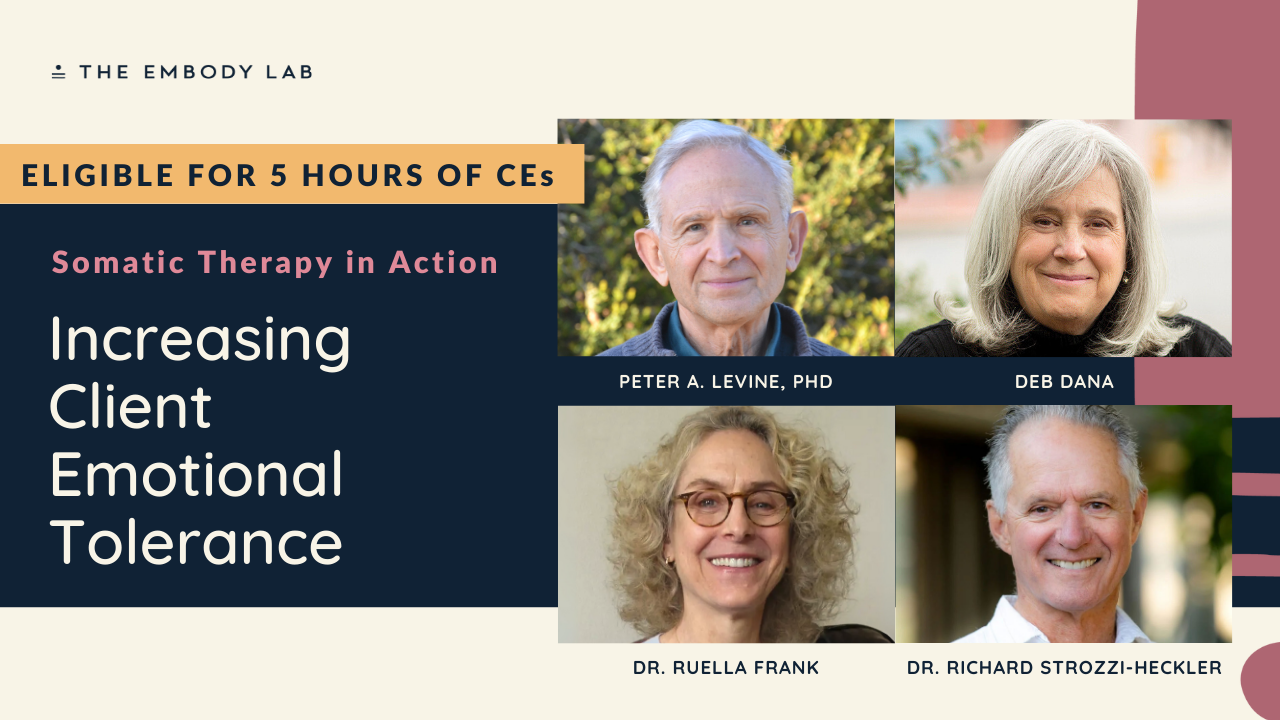
Somatic Therapy in Action: Increasing Client Emotional Tolerance
$397 USD $197
Special Price though March 10th
On-Demand Course Length: 5 Hours
This course offers a rich exploration of somatic therapy through four powerful demonstration sessions led by experienced expert practitioners. Each module showcases distinct approaches to working with nervous system regulation, trauma, and emotional resilience through body-based awareness, imagery, and therapeutic presence. From befriending anxiety, medical trauma, navigating hyperarousal, to processing stored trauma these sessions emphasize the body’s innate capacity for healing and integration. Together, they provide a rich resource for students and practitioners seeking to deepen their understanding of somatic principles in action.
ADD TO CARTAbout this course
Somatic Mastery in Action: Expert Demonstrations in Nervous System Regulation and Trauma Healing
Theory can only take you so far. True mastery comes from witnessing skilled practitioners navigate the nuanced terrain of nervous system dysregulation, trauma processing, and emotional healing in real time. This educational package offers an invaluable window into the art of somatic therapy through four powerful demonstration sessions led by world-renowned experts, each showcasing distinct approaches to working with the body's innate capacity for healing and integration.
Learning Through Observation:
From befriending anxiety and processing medical trauma to navigating hyperarousal and releasing stored trauma, these sessions reveal how master clinicians track subtle shifts, pace interventions, and create conditions for transformation. Together, they provide a rich resource for students and practitioners seeking to deepen their understanding of somatic principles in action—not as abstract concepts, but as lived therapeutic moments unfolding in the body.
What You'll Learn:
Through four comprehensive demonstration modules, you'll discover how to:
Module 1: The Journey to Nervous System Regulation Through Imagery and Pendulation with Deb Dana
Exploring Nervous System States:
- Facilitate exploration of different nervous system states (homeostasis, sympathetic arousal, dorsal collapse)
- Use imagery as a framework for understanding nervous system responses
- Guide participants through metaphorical landscapes (field of wildflowers, misty forest, deep water)
- Notice corresponding bodily sensations to each state
Ventral Vagal Anchoring:
- Establish ventral vagal anchoring as foundational step in somatic work
- Help participants identify and connect with felt sense of safety
- Build regulation as a resource for navigating other nervous system states
- Work with over-functioning and sympathetic activation patterns
Therapeutic Tracking and Pacing:
- Attend to and follow verbal and nonverbal cues
- Track shifts in language and bodily sensations (heat, shakiness)
- Notice emotional expressions as indicators of nervous system movement
- Apply pacing and titration for effective somatic work
- Deepen participant self-awareness through attentive following
- Understand the window of tolerance and how to work within it
Module 2: A Path to Trust and Connection Through Somatic Exploration with Dr. Ruella Frank
Gestalt Somatic Approach:
- Attend to participant's embodied experience through body awareness exercises
- Notice shifts in posture and breath
- Invite articulation of sensations and their potential meanings
- Work with vigilance and discomfort in the therapeutic setting
Horizontal Therapy:
- Focus on what emerges in immediate interaction between therapist and participant
- Work with present moment rather than solely exploring historical content
- Consistently include therapist's presence and influence in the therapeutic field
- Understand therapist attunement and ability to create safe space
Following the Figure of Interest:
- Track verbal and nonverbal expressions
- Notice shifts in language (from impersonal "it" to personal "I")
- Observe bodily gestures like reaching
- Explore statements about feelings (vigilance, trust)
- Deepen self-awareness through following what emerges
- Work with relational dynamics in the present moment
Module 3: A Body-Centered Approach to Reduce Anxiety with Dr. Richard Strozzi-Heckler
Befriending Anxiety Somatically:
- Prioritize present moment bodily sensations over cognitive narrative
- Notice physical sensations related to social anxiety (churning stomach, tight jaw)
- Shift focus from story to felt experience
- Cultivate acceptance in the presence of anxiety
Somatic Techniques for Safety:
- Apply breathwork for nervous system regulation
- Use centering practices to ground in the body
- Employ affirmations that land somatically ("I am safe," "You belong")
- Connect with feelings of safety and aliveness through body awareness
- Utilize external resources (like supportive presence of a plant)
Strategic Questioning:
- Elicit deeper understanding through precise questions
- Move beyond vague language ("interesting") to specific articulation
- Encourage more accurate description of internal experiences
- Move conversation forward through skillful inquiry
- Build participant's capacity for self-awareness
Module 4: Healing Pain Through Embodied Practice with Dr. Peter Levine
Understanding Pain in the Body:
- Recognize how trauma gets stuck in the body
- Identify chronic pain and bracing patterns as held trauma
- Understand self-perpetuating cycle of pain, fear, and anxiety
- Work with physical manifestations alongside emotional experiences
- Address impact of medical trauma and dismissal of symptoms
Somatic Experiencing Techniques:
- Apply directed movement to process stored trauma
- Use sound and vocalization for release
- Practice titrated exposure to challenging sensations (localized or radiating pain)
- Engage with resourcing experiences (supportive people, nature, joyful memories)
- Promote nervous system's natural pendulation and flow
- Explore moments of support and joy as counterbalance
The Power of Slowing Down:
- Utilize slowing down as conscious therapeutic choice
- Allow nervous system to integrate new embodied experiences gradually
- Prioritize present-moment physical sensations and their changes
- Focus on somatic experience over narrative details of past trauma
- Understand role of narrative versus somatic experience in trauma work
- Recognize significance of positive attachment figures in healing
Core Competencies Developed Across All Modules:
Nervous System Literacy:
- Track states of regulation and dysregulation
- Understand sympathetic activation, dorsal shutdown, and ventral regulation
- Work with the window of tolerance
- Support movement between states through body awareness
Therapeutic Presence and Tracking:
- Develop exquisite attunement to subtle shifts
- Follow verbal and nonverbal cues simultaneously
- Pace interventions based on nervous system capacity
- Create safe containers for vulnerable exploration
Body-Based Interventions:
- Use imagery and metaphor to access nervous system states
- Apply breathwork, centering, and grounding practices
- Employ movement, sound, and vocalization therapeutically
- Work with pendulation between activation and ease
Working with Specific Challenges:
- Address anxiety through befriending rather than fighting
- Process medical trauma and chronic pain
- Navigate hyperarousal and over-functioning patterns
- Release stored trauma through gentle techniques
Resourcing and Integration:
- Identify and strengthen internal and external resources
- Use positive experiences and memories therapeutically
- Support integration of new experiences
- Build capacity for self-regulation
Expert Faculty:
Learn from pioneers in somatic therapy: Deb Dana (Polyvagal Theory), Dr. Ruella Frank (Gestalt somatic therapy), Dr. Richard Strozzi-Heckler (Somatic Coaching), and Dr. Peter Levine (Somatic Experiencing®)—each bringing decades of experience and unique approaches to body-based healing.
The Demonstration Advantage:
Watching master clinicians work in real time offers learning impossible to gain from books or lectures alone. You'll witness:
- How they establish safety and build trust
- The micro-adjustments they make based on subtle cues
- How they pace interventions and titrate intensity
- When they slow down, when they explore, when they resource
- The language they use and how they use it
- How they track their own responses alongside the client's
- The art of following what emerges rather than imposing technique
Diverse Approaches, Common Principles:
While each demonstration showcases a distinct therapeutic approach, common threads emerge:
- The body holds wisdom that transcends narrative
- Slowing down allows integration
- Resources must be built before processing trauma
- The therapeutic relationship itself is regulatory
- Present-moment awareness is the foundation
- The nervous system has innate capacity for healing
Transformation Through Witnessing:
This package supports professionals in:
- Understanding somatic principles as lived experience, not just theory
- Developing eye for subtle somatic indicators
- Building confidence in body-based interventions
- Learning to pace trauma work appropriately
- Cultivating therapeutic presence that regulates
- Trusting the body's capacity for healing
Who This Is For:
Essential viewing for:
- Therapists and counselors expanding into somatic work
- Somatic practitioners refining their skills
- Students of body-based therapies
- Experienced clinicians seeking to deepen their practice
- Anyone working with trauma, anxiety, or chronic pain
- Practitioners wanting to see theory come alive in practice
These demonstrations illuminate the profound truth that healing happens not through the mind alone, but through the body's capacity to process, release, and integrate what has been held. Watch these masters work, and discover what becomes possible when we trust the body's innate wisdom.
Join our brilliant experts for the following sessions:
DEB DANA
Deb Dana, LCSW is an author, clinician, and consultant specializing in using the lens of Polyvagal Theory to understand and resolve the impact of trauma and create ways of working that honor the role of the autonomic nervous system. She developed the Rhythm of Regulation Clinical Training Series and lectures internationally on ways Polyvagal Theory informs work with trauma survivors. She is a founding member of the Polyvagal Institute, clinical advisor to Khiron Clinics, and an advisor to Unyte.
Deb’s clinical work published with W.W. Norton includes The Polyvagal Theory in Therapy: Engaging the Rhythm of Regulation, Polyvagal Exercises for Safety and Connection: 50 Client Centered Practices, and the Polyvagal Flip Chart. She partners with Sounds True to bring her polyvagal perspective to a general audience through the audio program Befriending Your Nervous System: Looking Through the Lens of Polyvagal Theory and her forthcoming print book Anchored: How to Befriend Your Nervous System Using Polyvagal Theory.
To learn more, visit rhythmofregulation.com or polyvagalinstitute.org
DR. RUELLA FRANK
Ruella Frank, Ph.D., is founder and director of the Center for Somatic Studies, faculty at the New York Institute for Gestalt Therapy, Gestalt Associates for Psychotherapy and Training, adjunct faculty at Gestalt Institute of Toronto, and also teaches throughout the United States, Europe, South America, Canada and Mexico. Ruella has authored chapters in various publications, as well as published several books: Body of Awareness: A Somatic and Developmental Approach to Psychotherapy, (GestaltPress, 2001), The First Year of The Rest of Your Life: Movement, Development and Psychotherapeutic Change, (Routledge Press, 2010), and The Bodily Roots of Experience in Psychotherapy (Routledge Press, 2022).
Website: www.somaticstudies.com/ruella-frank/
DR. RICHARD STROZZI-HECKLER
Richard Strozzi-Heckler has a Ph.D. in Psychology and is a seventh-degree black belt Shihan in aikido. He is a cofounder of the Lomi School and Tamalpais Aikido, and founder of Two Rock Aikido and Strozzi Somatics and Somatic Coaching. He is also
the cofounder of the Mideast Aikido Project and Training across Borders, organizations that bring citizens from warring countries together to practice aikido, and he’s the chairman of the board of Aikido Ethiopia. Richard was featured on the front page of the Wall Street Journal for developing the groundbreaking leadership program for the United States Marine Corps and was named one of the top fifty executive coaches in The Art and Practice of Leadership Coaching and in Profiles in Coaching. He was also an advisor to General Jim Jones, the Supreme Allied Commander of Europe from 2003 to 2006 in Afghanistan. Richard is a pioneer in bringing somatics and embodiment practices to education, health care, leadership, team development, military, technology, and international peace work. He is the author of nine books including The Leadership Dojo, In Search of the Warrior Spirit and Embodying the Mystery: The Wisdom of Somatics for Emotional, Energetic, and Spiritual Awakening. He lives and works on Coast Miwok land in the Stemple Creek watershed in the foothills of Northern California.
Website: www.strozziinstitute.org/
Facebook: StrozziInstitute
Instagram: @strozzi-institute
DR. PETER LEVINE
Peter A Levine, Ph.D., is the developer of Somatic Experiencing®, a naturalistic and neurobiological approach to healing trauma, which he has developed over the past 50 years. He holds a doctorate in Biophysics from UC Berkeley and a doctorate in Psychology from International University. He is the Founder and President of the Ergos Institute for Somatic Education, dedicated to Community Outreach and Post-Advanced Somatic Experiencing® Training, and the Founder and Advisor for Somatic Experiencing International. He has taught at the University of California, Berkeley; Mills College; Antioch University; the California Institute of Integral Studies; and the Santa Barbara Graduate Institute. His work has been taught to over 30,000 therapists in over 42 countries.
Dr. Levine is the author of several best-selling books on trauma, including Waking the Tiger, Healing Trauma (published in over 29 languages); In an Unspoken Voice, How the Body Releases Trauma and Restores Goodness; and Trauma and Memory, Brain and Body in a Search for the Living Past.
In recognition of his groundbreaking therapeutic works, Dr. Levine has received Lifetime Achievement awards from Psychotherapy Networker and from the US Association for Body-Oriented Psychotherapy, an honorary award as the Reiss-Davis Chair in Los Angeles for his lifetime contribution to infant and child psychiatry, and a Lifetime Achievement Award from the Association for Training on Trauma and Attachment in Children (ATTACh) for “his lifelong commitment to healing children through research, education, and outreach.” He served as a Stress consultant for NASA in the early space shuttle development and has served on the American Psychological Association task force for responding to the trauma of large-scale disasters and ethnopolitical warfare. He is currently a Senior Fellow and consultant at The Meadows Addiction and Trauma Treatment Center in Wickenburg, Arizona, and continues to teach trauma healing workshops internationally.
Websites: www.somaticexperiencing.com, www.traumahealing.org
DR. SCOTT LYONS
Dr. Scott Lyons is a licensed holistic psychologist, educator and author of the book Addicted to Drama: Healing Dependency on Crisis and Chaos in Yourself and Others, with Hachette publishing. Scott is also the host of The Gently Used Human Podcast, a delightfully depthful and often hilarious exploration of what it is to be human, to have lived life, and come out gently used.
As a renowned body-based trauma expert, Doctor of Osteopathy (Spain) and Mind-Body Medicine specialist, Scott helps people to break free from cycles of pain, limited beliefs, and trauma. Scott is an innovator in transformative wellness and trauma therapy, teaching over half a million people internationally over the past twenty years how to relieve stress and restore vitality. Scott has worked with many of the country’s top leaders and CEOs as an executive coach and wellness consultant.
Scott is the creator of The Embody Lab—the largest online learning platform for body-based trauma therapies—and developer of Somatic Stress Release™, a holistic process of restoring biological resilience, taught in over 20 countries.
Scott is a Certified Body-Mind Centering™ Teacher and Practitioner, Cranio-Sacral Therapist, Visceral Manipulation Therapist, Neuro-Developmental Therapist, Infant Developmental Movement Educator, Registered Movement Therapist and Educator, Trauma Therapist, Somatic Experiencing Practitioner, Thai Massage Practitioner, Clinical Hypnotherapist, Mindfulness-based Executive Coach, Experiential Anatomy/ Developmental Movement and Yoga Practitioner, and a 500-hour registered yoga teacher. Additionally Scott holds a BFA in Theater/Psychology, MFA in Dance/Choreography, MS in Clinical Psychology, and a PhD in Clinical Psychology and Mind-Body Medicine.
Scott has been featured in The New York Times, Vanity Fair, Forbes Women, Fast Company, The Telegraph, The Guardian, INC., CNBC Make It, Fortune, Bustle, Reader’s Digest and Goop. He has also appeared on The Mel Robbins Podcast, The Jordan Harbinger Show, The We Can Do Hard Things Podcast, The Mental Illness Happy Hour, The Human Upgrade, The Genius Life, and The Chopra Well.
Websites: www.TheEmbodyLab.com, www.drscottlyons.com
Instagram: @DrscottLyons

Guided full-length demonstrations
Observe four full-length somatic therapy sessions with clients. Each demonstration has a detailed breakdown and guided reflections of the session.

Powerful tools for your practice
In each session, the facilitator will walk you through what they did, why they did it, and how to adapt the same tools to your own practice.

Learn on your schedule
Get lifetime access to all your sessions. Download videos, audio files, and complete transcripts. Learn anywhere, anytime, on your schedule.
What Customers Are Saying
Alex T.
"This course transformed my approach, my clients now build resilience more effectively, experiencing deeper emotional healing."
Darcy M.
"Clear and practical sessions that significantly enhanced my understanding of somatic principles. A must-have for therapists!"
George G.
"Deeply insightful demonstrations. I'm now confident guiding clients through trauma processing with greater sensitivity and effectiveness."
List your practice on The Embody Lab’s Somatic Therapist & Practitioner Directory!
More somatic therapy seekers come to The Embody Lab in their search for the right therapist than to any other somatic therapy site. We’ll help your practice be seen by hundreds of thousands of potential clients seeking your services.
Join The Directory Here.